
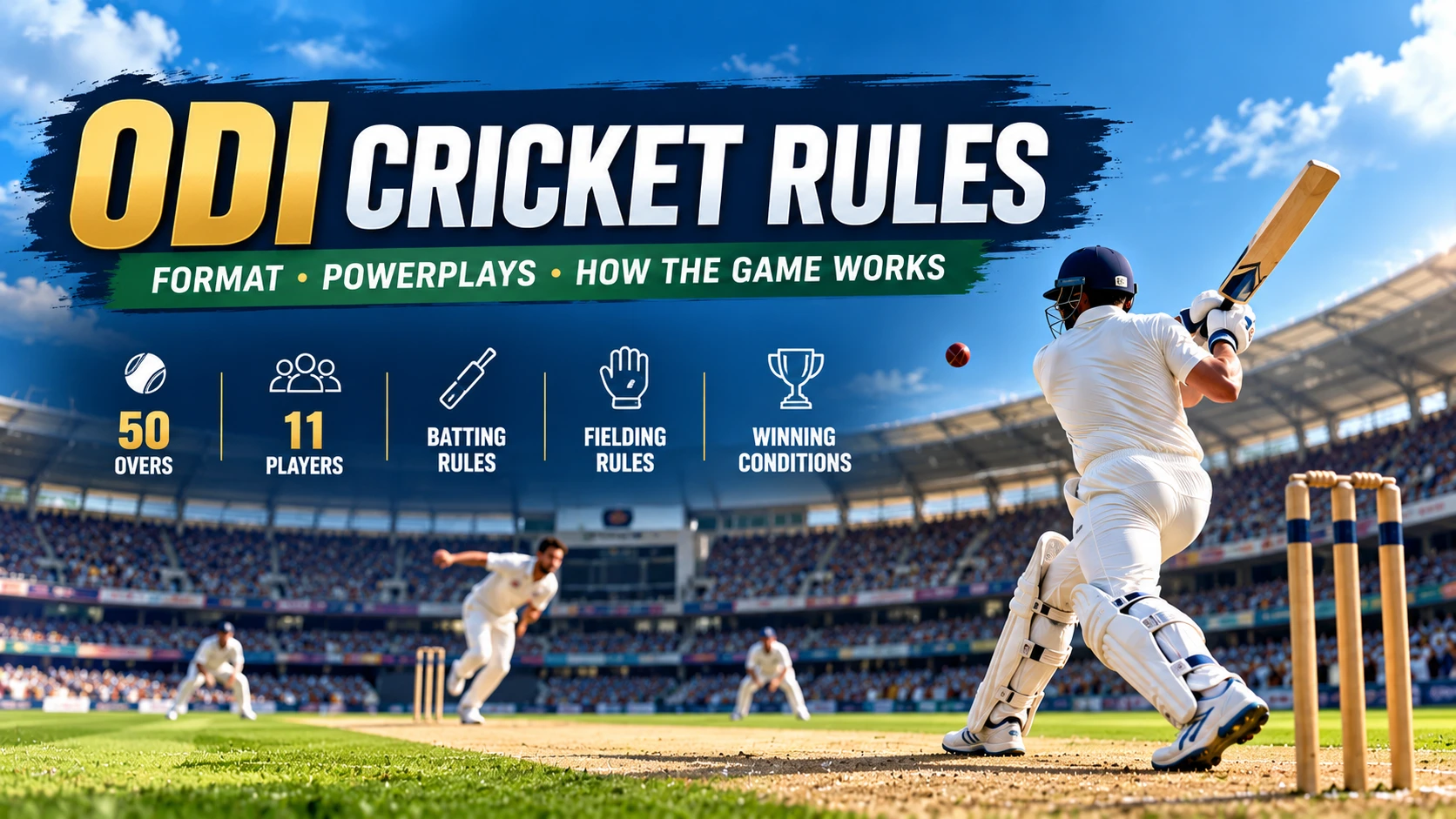
A One Day International looks simple from the stands: two teams, 50 overs each, highest score wins. Underneath, though, the ODI cricket rules decide a great deal, from how many fielders can guard the boundary to what happens when rain arrives mid-chase. This guide is based on the current ICC Men’s ODI Playing Conditions, which took effect in July 2025. It covers the 50-over format, the three powerplay phases, bowling limits, the new-ball rule, rain-affected matches and every way an ODI can end.
What Is One Day International Cricket?
One day international cricket is a limited-overs format between international teams, in which each side bats once for a fixed number of overs. The first ODI was played between Australia and England at Melbourne in January 1971, after rain washed out the opening days of a Test.
The name reflects its design: an ODI is scheduled to finish in one day, in two sessions of three and a half hours. Tests last up to five days with two innings per side, while T20Is cap each innings at 20 overs. ODIs sit in between, giving batters time to build an innings while demanding a steady scoring rate.
How Many Overs Are There in ODI Cricket?
If you’re wondering how many overs in ODI cricket, the answer is a maximum of 50 per innings. Each over has six valid deliveries, so a full innings contains 300 legal balls. Wides and no-balls don’t count towards the six.
An innings ends early if the batting side is all out or when the chasing team passes the target. If the side batting first is bowled out early, the chasing side still gets its full 50 overs.
When time is lost, overs are cut at 14.28 per hour, aiming to keep both innings equal.
ODI Cricket Rules and Match Format
Each ODI is played between two teams of 11 players. The toss winner chooses to bat or field first, and that decision cannot be changed.
- First innings: The side batting first scores as many runs as it can in 50 overs or until it is bowled out. Its total plus one becomes the target.
- Second innings: The chasing side tries to reach that target within its allotted overs.
- Scoring: Runs come from running, boundaries and extras such as wides, no-balls, byes and leg byes. Every no-ball is followed by a free hit.
No bowler may bowl more than 10 overs in a full innings, or two overs in a row. In shortened matches, each bowler is limited to one-fifth of the innings, with extra overs allowed when the total doesn’t divide evenly. In a 32-over innings, for example, two bowlers can bowl seven overs and the rest six.
Since July 2025, the fielding side uses two new balls, one from each end, for overs 1–34, then picks one of them for the rest of the innings. Matches cut to 25 overs or fewer before the start use one ball per innings.
ODI Powerplay Rules Explained
The ODI powerplay rules split every innings into three fielding phases. The restriction area is the “inner circle”, made of two 30-yard semi-circles around each set of stumps joined by straight lines.
| Powerplay | Overs | Maximum fielders outside the restriction area |
|---|---|---|
| Powerplay 1 | 1–10 | 2 |
| Powerplay 2 | 11–40 | 4 |
| Powerplay 3 | 41–50 | 5 |
With only two fielders in the deep early on, lofted shots over the infield carry less risk. Four boundary fielders in the middle overs let captains build pressure with spin, and five in the final phase protect bowlers as batters accelerate.
Slow over rates carry a fielding penalty: if the fielding side isn’t ready to bowl its final over by the cut-off time, only four fielders may stay outside the circle.
What Happens When Rain Interrupts an ODI Match?
Reduced overs: For a result to be possible, the team batting second must have the chance to face at least 20 overs, unless it is bowled out or reaches its target earlier.
Revised target and DLS: Targets are recalculated using the Duckworth-Lewis-Stern (DLS) method. It weighs the overs and wickets a team has left, not just overs. If a chase is abandoned after 20 overs, the result is decided against the DLS par score.
Adjusted powerplays: Each phase is shortened using a table in the playing conditions. An ICC example shows a 50-over innings cut to 32 overs being split into phases of 7, 19 and 6 overs.
Simplified illustration, not an official calculation: if a chase of 281 is cut to 40 overs, the new target isn’t just four-fifths of 281, because DLS also counts wickets in hand.
How Is an ODI Match Won?
- Win by runs: The side batting first wins by its margin in runs if the chase falls short.
- Win by wickets: The chasing side wins by the number of wickets it still has in hand when it reaches the target.
- Tie and Super Over: Under the standard playing conditions, equal scores lead to a Super Over, repeated if needed. If Super Overs can’t be completed, the match is a tie. Individual competitions may set their own rules.
- No result: If the teams haven’t both had the chance to face 20 overs, and the match hasn’t been decided earlier, it is a no result.